Eye Injections (Intravitreal Injection): Does It Hurt?
An intravitreal injection delivers medication inside the eye to treat retinal disease. When it is needed, how the procedure goes, whether it hurts, and the risks.
The words "an injection in the eye" frighten almost everyone. In reality, intravitreal injection is the most common procedure performed inside the eye worldwide. The injection itself takes a few seconds, the eye is numbed beforehand, and most patients feel only pressure.
For many people with retinal disease these injections are the way to keep their sight. And in some emergencies a timely injection decides whether the eye can be saved.
What an Intravitreal Injection Is
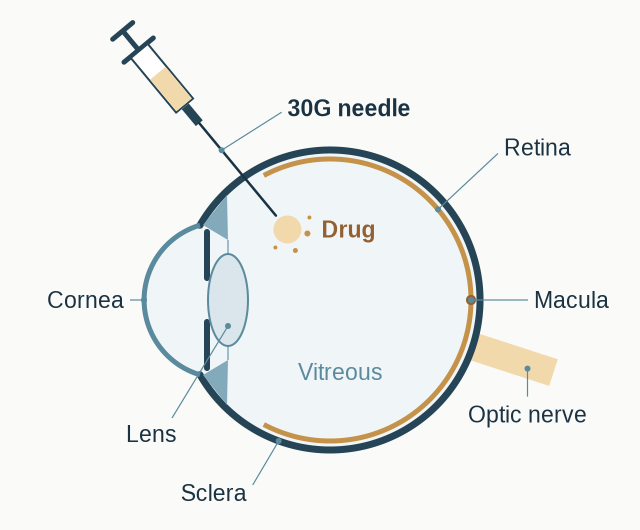
It is the delivery of medication into the vitreous — the clear gel that fills the inside of the eye. This way the drug reaches the retina directly and in the concentration needed: drops and tablets do not get there in sufficient amounts.
When It Is Prescribed
- Wet age-related macular degeneration — injections of anti-VEGF drugs that stop the growth of abnormal blood vessels
- Diabetic macular edema and diabetic retinopathy
- Retinal vein occlusion with macular edema
- Uveitis (inflammation inside the eye) and some other inflammatory conditions — steroid injections
- Endophthalmitis — a severe infection inside the eye, when an antibiotic must be given urgently
Anti-VEGF drugs are well studied. A Cochrane review, which pools the results of clinical trials, found that in wet macular degeneration they help maintain visual acuity and, in some patients, improve it.
Not Every Injection Goes Into the Eye
Patients often say they had "injections in the eye ten days in a row". Most likely those were subconjunctival injections — under the mucous membrane, not inside the eye. These may indeed be given as a course. An intravitreal injection in the same eye is given no more than once a month.
How the Procedure Goes
- The eye is numbed with drops or gel; sometimes a small numbing injection under the conjunctiva is added
- The eyelid skin and the surface of the eye are cleaned with an antiseptic, povidone-iodine. This is the main protection against infection
- A lid speculum holds the eyelids open so that you cannot blink during the injection
- You are asked to look in a certain direction, and the doctor injects the drug with a thin needle through the white of the eye (the sclera). This takes a few seconds
- After the injection the doctor checks the eye. The whole procedure takes about 10–15 minutes
Does It Hurt?
Most patients feel pressure and little or no pain. The needle is very thin — usually 30-gauge, thinner than the one used to draw blood and similar to an insulin needle. A systematic review of nine studies (about a thousand patients) confirmed that the thinner the needle, the less the pain. Needles of 30 gauge or thinner keep discomfort to a minimum.
Numbing can be done with drops, gel or an injection under the conjunctiva. Studies have not shown any one method to be clearly better than the others. The lid speculum and the stinging from the antiseptic in the first hours afterwards can be more unpleasant than the injection itself.
What Is Normal After an Injection
- A red spot on the white of the eye at the injection site — a small bleed under the conjunctiva that clears in about a week
- A foreign-body sensation, stinging and watering on the first day — a reaction to the antiseptic; preservative-free lubricating drops help
- A few floaters or round "bubbles" in your vision during the first 24 hours
- Briefly blurred vision
On the day of the injection, don't rub the eye, keep water out of it and don't use eye makeup. Use only the drops your doctor has prescribed.
Risks and Warning Signs
Serious complications are very rare. The most dangerous is endophthalmitis, an infection inside the eye. In a pooled analysis of 43 studies it occurred after 197 of 350,535 injections. That is 0.056%, or roughly one case per 1,800 injections. Other rare complications include bleeding into the vitreous and retinal detachment.
Contact your doctor the same day if, after an injection:
- The eye hurts and the pain is getting worse
- Your vision is getting worse
- The redness is increasing rather than fading
- You develop marked sensitivity to light
- Floaters increase after the first day
How Many Injections Are Needed
Wet macular degeneration and diabetic macular edema are chronic conditions, so a single injection is usually not enough. Treatment most often starts with several monthly injections, after which the intervals are gradually extended based on OCT, a layer-by-layer scan of the retina. Don't skip scheduled injections: vision lost during a gap cannot always be regained.
How to Protect Your Retina
- Have regular preventive eye exams — after 50, including an examination of the retina
- If you have diabetes, have your retina checked at least once a year and keep blood glucose and blood pressure under control
- Don't smoke — smoking raises the risk of macular degeneration
- Protect your eyes from injury: wear safety glasses for repairs and work with tools
- Don't put off a visit if straight lines start to look wavy or a spot appears in the center of your vision
If you have been prescribed intravitreal injections or have noticed changes in your vision, book a consultation with ophthalmologist Iryna Hetman — call +380 99 828 08 84 or use the contact form on this website.
Sources
- 1.American Society of Retina Specialists. Intravitreal Injections (Retina Health Series)
- 2.Avery R.L. et al. Intravitreal injection technique and monitoring: updated guidelines of an expert panel. Retina, 2014
- 3.Grzybowski A. et al. 2018 Update on Intravitreal Injections: Euretina Expert Consensus Recommendations. Ophthalmologica, 2018
- 4.Fileta J.B. et al. Meta-analysis of infectious endophthalmitis after intravitreal injection of anti-vascular endothelial growth factor agents. Ophthalmic Surgery, Lasers and Imaging Retina, 2014
- 5.Butler E.T.S. et al. Effect of needle gauge size on pain during intravitreal anti-VEGF injection: a systematic review and network meta-analysis. Ophthalmology and Therapy, 2024
- 6.Han J. et al. Anesthesia for intravitreal injection: a systematic review. Clinical Ophthalmology, 2020
- 7.Solomon S.D. et al. Anti-vascular endothelial growth factor for neovascular age-related macular degeneration. Cochrane Database of Systematic Reviews, 2019

Article Author
Iryna HetmanOphthalmologist, Cataract Surgeon · Kyiv Hospital #4 · Viva Clinic
- Over 500 successful surgeries
- Member of ESCRS and USCRS
Book an Appointment
Have questions? Schedule a consultation
Ophthalmologist Iryna Hetman sees patients at Kyiv City Clinical Hospital #4 and Viva Medical Clinic in Chaiky. Book your appointment today.
Book Now