Recovery After Cataract Surgery: What You Can Do and When
When vision becomes clear after cataract surgery, what recovery depends on, when you can read, drive and go back to work, and why heavy lifting has to wait a month.
After cataract surgery, patients most often ask when their vision will be clear and when they can get back to normal life: reading, driving, going to work. The answer depends on how dense the cataract was and on the condition of the cornea. Below are the typical timelines and restrictions the doctor explains before surgery.
In short:
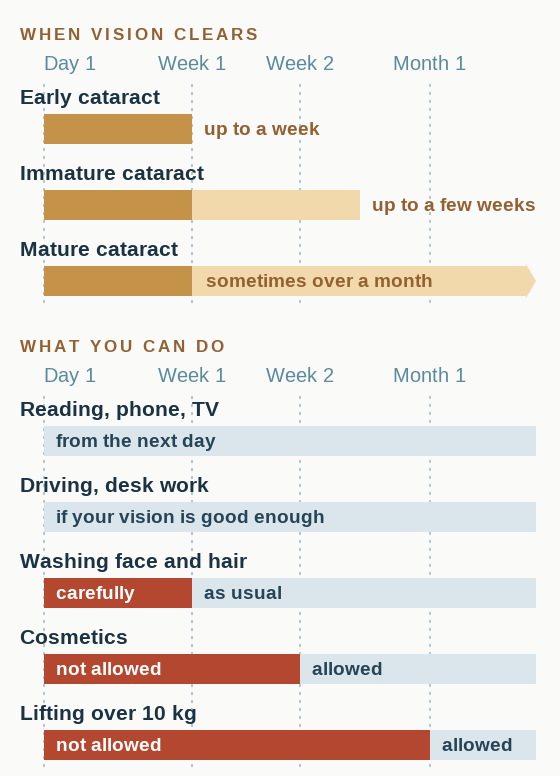
- Reading, watching TV and using your phone are fine from the next day — as long as you feel comfortable
- Driving and going back to work that involves no physical strain are possible from the next day, if your vision is clear enough and you feel comfortable
- No lifting over 10 kg for a month
- Vision can be clear as early as the next day, but after a mature cataract recovery sometimes takes more than a month
What Determines When Vision Becomes Clear
Recovery time differs from person to person. It depends on how cloudy and dense the lens was, on the patient's age and on the eye itself — above all on the condition of the cornea and its ability to recover.
The denser the cataract, the more ultrasound energy it takes to break up and remove the lens, and the more stress falls on the cornea. After such surgery the cornea may swell for a while, and vision is blurry, as if looking through a fogged-up window. The swelling clears on its own, but it takes time. In a study of 859 eyes, the hardness of the lens nucleus was the main factor determining how many corneal cells were lost during surgery.
Typical timelines by cataract stage:
- Early cataract — good vision may come literally the next day or settle within a week
- Immature cataract (moderate clouding and density) — on average up to a week, sometimes up to a few weeks
- Mature cataract — from a week to a month, sometimes longer
This is one more reason not to wait for a cataract to "ripen": the denser the lens, the longer vision takes to recover. Glasses for everyday wear are prescribed once vision has stabilized.
Why Corneal Cells Are Counted Before Surgery
The inner layer of the cornea, the endothelium, works like a pump: it constantly removes excess fluid from the cornea, which keeps it clear. In adults these cells practically do not regenerate, so their number is the reserve the cornea relies on to get through surgery.
Any operation costs some of these cells. In one study, a year after phacoemulsification the center of the cornea had on average 8.5% fewer cells. A healthy cornea does not notice this, but when the reserve is small, the cornea can stay swollen and vision blurry for a long time.
That is why endothelial microscopy, a count of the corneal cells, is done before surgery. If the count is critically low, for example in Fuchs dystrophy (an inherited corneal disease), it can affect the choice of operation: sometimes lens replacement is combined with a transplant of the inner corneal layer. In other cases the patient is told in advance that recovery may take longer.
Reading, TV, Phone — From the Next Day
There are no restrictions on using your eyes after cataract surgery. From the next day you can read, watch TV, work at a computer and use your smartphone — it will not harm the operated eye.
Let comfort be your guide. The first days may bring some discomfort; if so, pace yourself: take breaks when the eye gets tired and don't force yourself to read.
When You Can Drive and Go Back to Work
You must not drive on the day of surgery. From the next day you can, if your vision is clear enough and you feel comfortable. Whether your vision is good enough is checked at the follow-up visit, which is mandatory the day after surgery.
If the other eye has not been operated on yet and vision differs a lot between the eyes, it takes some getting used to: judging distances on the road can feel unusual at first. Tell your doctor, who will advise when it is safe to drive.
If your work involves no physical strain — office work or paperwork, for example — you can go back literally the day after. If your work is physical, the strain has to be limited for a month.
Physical Strain — Restricted for a Month
The main restriction after cataract surgery is physical. For a month, don't lift anything heavier than 10 kg: shopping bags, buckets of water, sacks in the garden. Strength training should also wait.
Ordinary housework, walks and light everyday tasks are fine. The doctor sets the length of the restrictions individually, depending on how the operation went and how the eye is healing: recovery usually takes from a few days to a month.
Caring for the Eye in the First Weeks
- Use the prescribed drops exactly as scheduled — don't stop them on your own, even if the eye already looks calm
- Don't rub or press on the operated eye
- For a week, keep water, soap and shampoo out of the eye
- For 2 weeks, don't use cosmetics
- For a month, don't lift over 10 kg and avoid bending down sharply
- Come to your follow-up visits as scheduled
When to See a Doctor Without Waiting for Your Follow-Up
Complications after cataract surgery are rare, but some symptoms need an eye exam the same day:
- Vision suddenly gets worse, or improves and then starts to drop
- Eye pain gets stronger instead of fading
- Redness increases or discharge appears
- Flashes of light, many new floaters, or a shadow covering part of your vision
Key Points
- Vision can be clear as early as the next day, but after a mature cataract recovery sometimes takes more than a month
- How long recovery takes depends on the density of the cataract and the condition of the cornea — which is why corneal cells are counted before surgery
- Reading, TV and phone are fine from the next day — as long as you feel comfortable
- Driving and work without physical strain — from the next day, if your vision is good enough
- Lifting over 10 kg — not before a month has passed
To book a cataract surgery consultation with ophthalmologist Iryna Hetman, see the contact details on this website: the phone numbers of both clinics and a form for questions.
Sources
- 1.Hayashi K. et al. Risk factors for corneal endothelial injury during phacoemulsification. Journal of Cataract and Refractive Surgery, 1996
- 2.Walkow T. et al. Endothelial cell loss after phacoemulsification: relation to preoperative and intraoperative parameters. Journal of Cataract and Refractive Surgery, 2000
- 3.Briceno-Lopez C. et al. Corneal edema after cataract surgery. Journal of Clinical Medicine, 2023
- 4.van Cleynenbreugel H. et al. Cataract surgery in patients with Fuchs' endothelial corneal dystrophy: when to consider a triple procedure. Ophthalmology, 2014
See Also

Article Author
Iryna HetmanOphthalmologist, Cataract Surgeon · Kyiv Hospital #4 · Viva Clinic
- Over 500 successful surgeries
- Member of ESCRS and USCRS
Book an Appointment
Have questions? Schedule a consultation
Ophthalmologist Iryna Hetman sees patients at Kyiv City Clinical Hospital #4 and Viva Medical Clinic in Chaiky. Book your appointment today.
Book Now