Does Cataract Always Mean Surgery? When to Replace the Lens
A cataract diagnosis does not automatically mean surgery. When lens replacement makes sense even at an early stage, and when it is postponed or not done at all.
The word "cataract" appears in an eye exam report, and many people immediately decide they need surgery, and the sooner the better. In fact, the diagnosis alone does not mean the lens has to be replaced. The decision depends on how the cataract affects your vision and daily life, whether there are other eye diseases, and how safe surgery is for you in particular.
Why Almost Everyone Over 50–60 Has Some Cataract
With age, the lens gradually becomes denser and loses its clarity — a natural process. That is why in some people after 50, and in others after 60, the doctor already sees age-related changes on a slit-lamp exam. Even a minimal pinpoint opacity in the lens is called a cataract, although it does not yet affect either the quality or the sharpness of vision.
When Surgery Is Not Needed
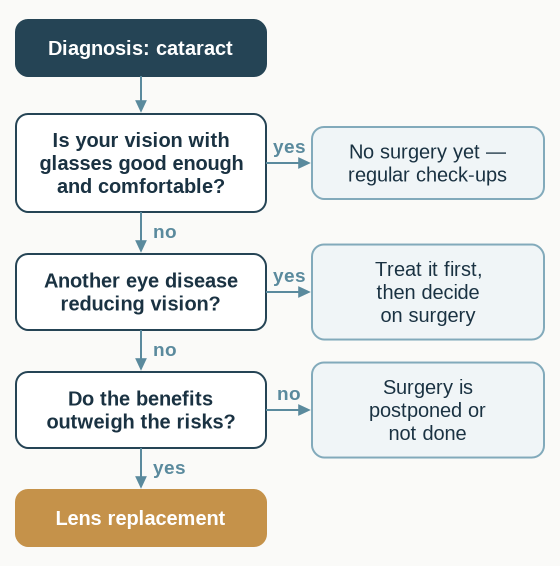
If you see 100% with glasses (visual acuity 1.0, or 20/20), notice no decline and feel comfortable, a cataract diagnosis is not a reason for surgery. Your vision without glasses may be reduced — what matters is how you see with the right correction.
In that case, regular eye exams are enough so as not to miss the moment the cataract starts to get in the way. It is also worth knowing that there are no drops or pills that dissolve a cataract. Once it starts to reduce vision, only surgery can help.
When Surgery Is Advised Even for an Early Cataract
Visual acuity is not the only criterion. If you are no longer comfortable with glasses, feel you see worse even with correction, or the quality of your vision has declined, lens replacement may be recommended even for an early cataract.
Quality of vision is more than lines on an eye chart. A cataract can cause glare from bright light and oncoming headlights, halos around lights, dull colors and reduced contrast — while visual acuity formally stays fairly good. That is why international guidelines advise deciding on surgery not by a number on the chart, but by whether vision meets the person's needs. The UK's NICE explicitly advises against restricting access to surgery on the basis of visual acuity, and the American Academy of Ophthalmology recommends surgery when vision no longer meets the patient's needs and surgery has a reasonable chance of improving it.
Research confirms the benefit of timely surgery. Among older drivers with cataract, those who had their lens replaced were involved in about half as many crashes over the following years as those who declined surgery. And according to a meta-analysis, surgery on the first eye reduces falls in older people by about a third.
When It Is Not the Cataract That Reduces Vision
Vision can also decline because of other eye diseases — glaucoma, damage to the macula (the center of the retina) or diabetic retinopathy, for example. Then a small cataract merely accompanies the main problem, and replacing the lens will not give the expected result.
If an early cataract comes with another disease in an acute stage, that disease has to be stabilized first — at that point it becomes the main problem. Only once it is under control is the question of lens replacement decided.
That is why, before deciding on surgery, the whole eye is examined — both the front and the back — to find out what is reducing vision most and where treatment should start. Such an examination usually includes:
- Visual acuity without glasses and with the best correction
- Intraocular pressure measurement
- A slit-lamp exam of the cornea, lens and other structures at the front of the eye
- An exam of the retina and optic nerve with a dilated pupil
- If needed, optical coherence tomography (OCT) of the retina and a corneal cell count
When the Risks Outweigh the Benefits
Before surgery, the doctor weighs two things: how likely vision is to improve, and the risk of complications. If the risks outweigh the benefits, surgery may be postponed or declined. Most often this concerns situations like these:
- The patient sees with only one eye, and that eye has another problem as well — for example, too small a reserve of corneal cells (a low endothelial cell count). Any complication in such an eye is especially dangerous
- Advanced, stage 3 glaucoma, when the optic nerve is already badly damaged. Eye pressure fluctuates during surgery, and in patients with glaucoma it can rise for a while afterwards — even a short pressure spike can harm the weakened nerve
Such pressure spikes are not a theoretical risk. In a study of patients with open-angle glaucoma, the day after surgery the pressure rose above 30 mmHg in about one in eight, compared with none of the patients without glaucoma.
In such cases the decision is made individually, taking into account how advanced the cataract is and how much it reduces vision, whether the patient's vision is enough for daily life, and whether they are prepared to accept the risks. Postponing surgery does not mean being left without care: the patient stays under the doctor's supervision, and the question of surgery is revisited when the situation changes.
No Need to Wait for the Cataract to "Ripen"
If a cataract already gets in the way of daily life, there is no point in putting surgery off. A mature cataract is denser: surgery on it is technically more difficult and carries a higher risk of complications, and vision takes longer to recover afterwards — sometimes more than a month.
What to Do If You Have Been Diagnosed With Cataract
- Don't panic: a diagnosis is not yet a referral for surgery
- Check how well you see with properly fitted glasses
- Have a full examination to find out what exactly affects your vision
- Tell your doctor how your vision affects your life: reading, work, driving, getting around at dusk
- If surgery is not needed yet, come for regular check-ups, and book sooner if your vision gets worse
Key Points
- A cataract diagnosis does not automatically mean surgery: minimal age-related lens opacities are present in almost everyone over 50–60
- If you see 100% with glasses and feel comfortable, no surgery is needed — regular check-ups are enough
- If your vision is unsatisfactory even with glasses, the lens can be replaced even for an early cataract
- First, the doctor checks whether another eye disease is reducing vision, and treats it if needed
- When the risks are high — for example, in an only eye or with advanced glaucoma — the decision is made individually, together with the patient
To book a consultation and a full examination before cataract surgery with ophthalmologist Iryna Hetman, see the contact details on this website: the phone numbers of both clinics and a form for questions.
Sources
- 1.Miller K.M. et al. Cataract in the Adult Eye Preferred Practice Pattern. American Academy of Ophthalmology. Ophthalmology, 2022
- 2.National Institute for Health and Care Excellence (NICE). Cataracts in adults: management (NG77), 2017
- 3.Owsley C. et al. Impact of cataract surgery on motor vehicle crash involvement by older adults. JAMA, 2002
- 4.Gutiérrez-Robledo L.M. et al. Effect of cataract surgery on frequency of falls among older persons: a systematic review and meta-analysis. Journal of Ophthalmology, 2021
- 5.Yasutani H. et al. Intraocular pressure rise after phacoemulsification surgery in glaucoma patients. Journal of Cataract and Refractive Surgery, 2004
See Also

Article Author
Iryna HetmanOphthalmologist, Cataract Surgeon · Kyiv Hospital #4 · Viva Clinic
- Over 500 successful surgeries
- Member of ESCRS and USCRS
Book an Appointment
Have questions? Schedule a consultation
Ophthalmologist Iryna Hetman sees patients at Kyiv City Clinical Hospital #4 and Viva Medical Clinic in Chaiky. Book your appointment today.
Book Now