Dexamethasone Eye Drops Without a Prescription: The Risks
Dexamethasone eye drops clear redness fast, but unsupervised use raises eye pressure and can lead to steroid-induced glaucoma and cataract. What to do instead.
Dexamethasone eye drops are among the cheapest and easiest to buy at a pharmacy in Ukraine. People use them for red eyes, conjunctivitis or allergy, often on a friend's advice or from their own experience. A few drops, and by the next day the eye is white again.
But dexamethasone is a steroid, and without an ophthalmologist's supervision it can quietly raise the pressure inside the eye. When that goes on for weeks and months, steroid-induced glaucoma develops — damage to the optic nerve that cannot be reversed.
Why Dexamethasone Seems to Work So Fast
Dexamethasone is a glucocorticosteroid — a powerful anti-inflammatory drug. It suppresses inflammation of any origin, reducing redness, swelling and itching. Ophthalmologists do prescribe steroid drops — after eye surgery, for uveitis (inflammation inside the eye), for severe allergic inflammation. But always for a defined period, on a set schedule and with eye pressure checks.
The problem is that a steroid removes the symptoms, not the cause. Bacterial or viral conjunctivitis, dry eye, blepharitis (inflamed eyelid margins), allergy — the eye looks calmer while the condition stays. Once the drops are stopped everything returns, and the person reaches for the familiar bottle again. That is how "a few days" turn into months.
A Case From Practice
A patient came in with ordinary conjunctivitis. Before the visit he had bought dexamethasone at a pharmacy on his own and used it for two days. The conjunctivitis was still there, and his eye pressure was above normal. The drops were stopped, the actual cause was treated, and the pressure returned to normal with no lasting harm.
This patient was lucky: the problem was caught at the very start. A pressure rise this early is the exception — it usually takes a few weeks of use. It is far worse when people with allergy or chronic inflammation of the eyelids and conjunctiva use dexamethasone for months because it is cheap and brings quick relief. They often reach a doctor with the optic nerve already damaged.
How Steroids Raise Eye Pressure
Fluid called aqueous humor is constantly produced inside the eye and drained out of it. Steroids change the trabecular meshwork — the "filter" this fluid leaves through. Drainage slows down and the pressure rises. There is no pain or redness, and vision stays good for a long time, so the person notices nothing.
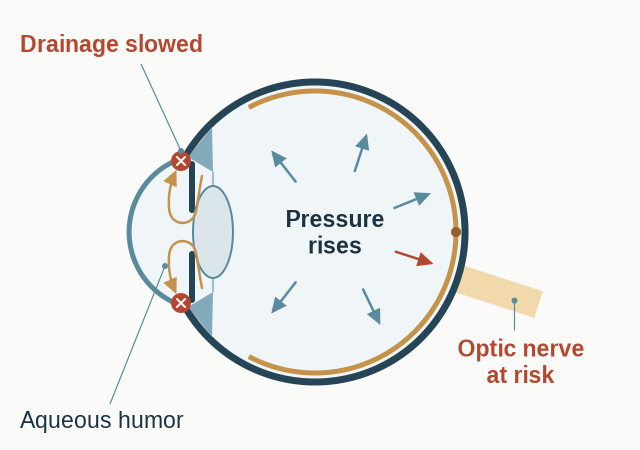
The pressure most often rises 3–6 weeks after starting the drops, although a response can come earlier or much later. Sensitivity varies: according to clinical reviews, about 5% of people have a marked pressure rise and roughly another third a moderate one. There is no way to tell in advance who will respond — which is why pressure is always measured during steroid treatment.
After the drops are stopped, pressure usually returns to normal within 1–4 weeks. After long-term use, however, it may stay high — then pressure-lowering drops and sometimes surgery are needed. And if high pressure has already damaged the optic nerve, the lost part of the visual field cannot be restored.
Who Is at Higher Risk
Steroids can raise eye pressure in anyone, but some people respond more often and more strongly:
- People with glaucoma or suspected glaucoma — up to 90% of patients with primary open-angle glaucoma respond to steroids
- Those whose parents or siblings have glaucoma
- People with high myopia
- People with diabetes
- Patients with connective tissue disease, especially rheumatoid arthritis
- Young children and older adults
- Anyone whose pressure has risen on steroids before
This is not only about eye drops. Steroid ointments and creams applied to the eyelid skin, inhalers, nasal sprays, tablets and injections can raise eye pressure too. If you use any of these long-term, tell your ophthalmologist.
Not Only Glaucoma: Other Risks
- Steroid cataract — with prolonged steroid use the lens can cloud over (posterior subcapsular cataract); it can only be treated surgically
- Worsening infections — steroids suppress local immunity, so herpes, bacterial or fungal infections of the cornea (keratitis) can progress under them
- Masked symptoms — the eye looks calm, so people seek help later
- Slower healing of the cornea after injuries and scratches
What to Do When Your Eye Is Red
- Don't start with steroid drops, and don't use a bottle left over from earlier treatment
- Take out contact lenses and leave them out until the eye settles
- If dryness and tiredness are the only complaints, preservative-free lubricating drops are fine
- If things are no better in 1–2 days, see an ophthalmologist: the cause of redness is visible on a slit-lamp exam
- Seek care the same day if you have pain, reduced vision, light sensitivity, pus-like discharge, an eye injury, or if you wear contact lenses
If You Are Already Using Dexamethasone
If a doctor prescribed the drops, follow the schedule, don't extend the course yourself and come to follow-up visits with a pressure check. If you started them on your own or have been using them for a long time, book an exam. The doctor will measure your pressure, assess the optic nerve and advise how to stop the drug safely and how to treat the real cause.
Key Points
- Dexamethasone calms inflammation but does not treat its cause
- Only a doctor should prescribe it — for a limited time and with eye pressure checks
- Steroid-related pressure rises without pain or symptoms, most often after 3–6 weeks
- Steroid-induced glaucoma is irreversible but preventable — don't prescribe eye drops for yourself
To book an eye exam with a pressure check with ophthalmologist Iryna Hetman, call +380 99 828 08 84 or use the contact form on this website.
Sources
- 1.Roberti G. et al. Steroid-induced glaucoma: epidemiology, pathophysiology, and clinical management. Survey of Ophthalmology, 2020
- 2.Phulke S. et al. Steroid-induced glaucoma: an avoidable irreversible blindness. Journal of Current Glaucoma Practice, 2017
- 3.Jobling A.I., Augusteyn R.C. What causes steroid cataracts? A review of steroid-induced posterior subcapsular cataracts. Clinical and Experimental Optometry, 2002
- 4.American Academy of Ophthalmology, EyeWiki. Steroid-Induced Glaucoma
See Also
Article Author
Iryna HetmanOphthalmologist, Cataract Surgeon · Kyiv Hospital #4 · Viva Clinic
- Over 500 successful surgeries
- Member of ESCRS and USCRS
Book an Appointment
Have questions? Schedule a consultation
Ophthalmologist Iryna Hetman sees patients at Kyiv City Clinical Hospital #4 and Viva Medical Clinic in Chaiky. Book your appointment today.
Book Now