Dry, Red Eyes: Which Drops to Choose and the 20-20-20 Rule
Why eyes get dry and red at the computer, how lubricating drops differ from redness-relieving ones, and how the 20-20-20 rule eases digital eye strain.
Burning, a gritty feeling, redness, tired eyes by the evening — complaints familiar to almost everyone who works at a computer. Most often the cause is dry eye disease. According to the international TFOS DEWS II report, it affects 5 to 50% of people, depending on the country and the diagnostic criteria. Women and older adults are affected more often.
The first thing most people do is buy drops that "get the red out". That is exactly where things usually go wrong.
What Dry Eye Disease Is
The surface of the eye is covered by the tear film — a thin layer of water, mucus and oils. It nourishes and protects the cornea and keeps vision sharp.
Dry eye is a disease of the eye's surface in which the tear film loses its stability. Either too few tears are produced, or they evaporate too quickly because the oily layer made by the meibomian glands in the eyelids is lacking. Most often both mechanisms are at work.
- Burning, stinging, a gritty or foreign-body sensation
- Redness and tired eyes, worse towards the evening
- Blurred vision that clears after blinking
- Watery eyes — a paradoxical response to a drying surface
- Sensitivity to light, wind and air conditioning
- Discomfort with contact lenses
Why Screens Dry Out Your Eyes
The main reason is that we blink less. People normally blink about 15 times a minute, but only 5–7 times when looking at a screen. In one classic study, office workers blinked 22 times a minute on average when relaxed and just 7 times while working at a monitor.
On top of that, many blinks at a screen are incomplete: the lids don't close fully, so the tear film isn't renewed and dries out. By some estimates, at least half of computer users have symptoms of digital eye strain.
Other factors add to the dryness:
- Dry air — heating, air conditioning, airflow directed at the face
- A monitor above eye level: the eyes open wider and tears evaporate faster
- Contact lenses
- Age and hormonal changes, especially in women
- Some medications, including antihistamines and antidepressants
- Chronic blepharitis and meibomian gland dysfunction
The 20-20-20 Rule
The simplest way to help your eyes is free: every 20 minutes, look at something 20 feet (about 6 meters) away for 20 seconds. In other words, look out of the window. In those seconds the muscle that focuses the eye up close relaxes.
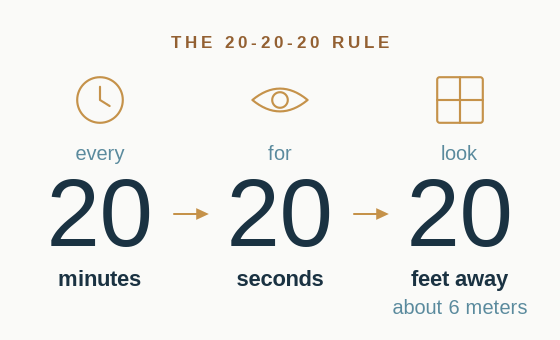
The rule has been tested: 29 computer users with eye complaints received reminders to take such breaks for two weeks. Their digital eye strain and dry eye symptoms decreased — but a week after the reminders were switched off the effect was gone. The takeaway is simple: the rule works for as long as you follow it. It is a habit, not a course of treatment.
- Place the monitor at arm's length, so that your gaze is directed slightly downward
- Blink deliberately and fully, especially when reading with concentration
- Humidify the air and don't sit in the direct flow of an air conditioner
- Give your eyes a rest from contact lenses — wear glasses for part of the day
Lubricating Drops: How to Choose
Lubricating drops — artificial tears — are the foundation of dry eye treatment. A Cochrane review of 43 clinical trials (almost 3,500 participants) concluded that they are probably safe and effective and that most products work similarly. So there are no "best drops for everyone" — the choice is individual, depending on the type of dry eye and on what is convenient to use.
- If you use drops more than four times a day or all the time, choose preservative-free ones. The most common preservative, benzalkonium chloride, itself damages the eye's surface with long-term use
- Thicker drops and gels last longer but blur vision for a few minutes — they are better suited for bedtime
- If you wear contact lenses, check that the drops are compatible with them
- If one product hasn't helped after 2–3 weeks of regular use, don't switch drops at random — have a doctor find the cause
Redness-Relieving Drops Don't Lubricate
Drops containing tetrahydrozoline (Visine and similar products) are decongestants. They narrow the blood vessels of the conjunctiva, and the eye turns white within minutes. But they neither lubricate the eye nor treat the cause of the redness. When the effect wears off the vessels widen again — often more than before. This is called rebound redness: the person uses the drops more often, and the eyes get redder and redder.
The American Academy of Ophthalmology advises using such drops only occasionally and for no more than 72 hours in a row. One study described 70 patients with conjunctivitis caused by the decongestant drops themselves. They had used them daily for a median of three years. After stopping, it typically took about four weeks for the eyes to recover.
People at risk of angle-closure glaucoma (narrow drainage angles) should not use these drops at all: they can trigger an acute attack.
An even worse choice for red eyes is steroid drops such as dexamethasone. They clear redness quickly, but unsupervised use raises the pressure inside the eye.
When to See an Ophthalmologist
- Lubricating drops haven't helped within 2–3 weeks, or you need them every hour
- You have pain, light sensitivity or reduced vision
- Only one eye is red
- There is pus-like discharge
- A red, painful eye in a contact lens wearer — a reason to seek care the same day
At the visit the doctor examines the surface of the eye and the lid margins at the slit lamp, a microscope for examining the eye. The doctor also assesses tear film stability and tear volume and, if needed, stains the surface with a special dye.
Treatment depends on the findings. Besides lubricating drops, it may include lid hygiene and warm compresses, prescription anti-inflammatory drops, or tiny plugs that close the tear drainage openings so that tears stay on the eye longer.
To book a consultation with ophthalmologist Iryna Hetman, call +380 99 828 08 84 or use the contact form on this website.
Sources
- 1.Craig J.P. et al. TFOS DEWS II Definition and Classification Report. The Ocular Surface, 2017
- 2.Stapleton F. et al. TFOS DEWS II Epidemiology Report. The Ocular Surface, 2017
- 3.Sheppard A.L., Wolffsohn J.S. Digital eye strain: prevalence, measurement and amelioration. BMJ Open Ophthalmology, 2018
- 4.Talens-Estarelles C. et al. The effects of breaks on digital eye strain, dry eye and binocular vision: testing the 20-20-20 rule. Contact Lens and Anterior Eye, 2023
- 5.Pucker A.D. et al. Over the counter (OTC) artificial tear drops for dry eye syndrome. Cochrane Database of Systematic Reviews, 2016
- 6.Baudouin C. et al. Preservatives in eyedrops: the good, the bad and the ugly. Progress in Retinal and Eye Research, 2010
- 7.Soparkar C.N. et al. Acute and chronic conjunctivitis due to over-the-counter ophthalmic decongestants. Archives of Ophthalmology, 1997
- 8.American Academy of Ophthalmology. Redness-Relieving Eye Drops, 2023
- 9.American Academy of Ophthalmology. Computers, Digital Devices, and Eye Strain, 2024

Article Author
Iryna HetmanOphthalmologist, Cataract Surgeon · Kyiv Hospital #4 · Viva Clinic
- Over 500 successful surgeries
- Member of ESCRS and USCRS
Book an Appointment
Have questions? Schedule a consultation
Ophthalmologist Iryna Hetman sees patients at Kyiv City Clinical Hospital #4 and Viva Medical Clinic in Chaiky. Book your appointment today.
Book Now